PERFORMANCE PATHWAY MODELS
We're not just teaching tennis. We're teaching players to love tennis.
The primary objective of the We Are Tennis Development Pathway is to develop a lifelong love of tennis while building the foundations required for future participation and performance.
We believe that enjoyment and engagement are essential to long-term development.
It is relatively easy to teach a forehand or a backhand. It is much more difficult to teach a player to love the game. For this reason, creating positive experiences is one of the most important responsibilities of every coach within the Development Pathway.
Fun is not the opposite of development.
Fun is the vehicle through which development occurs.
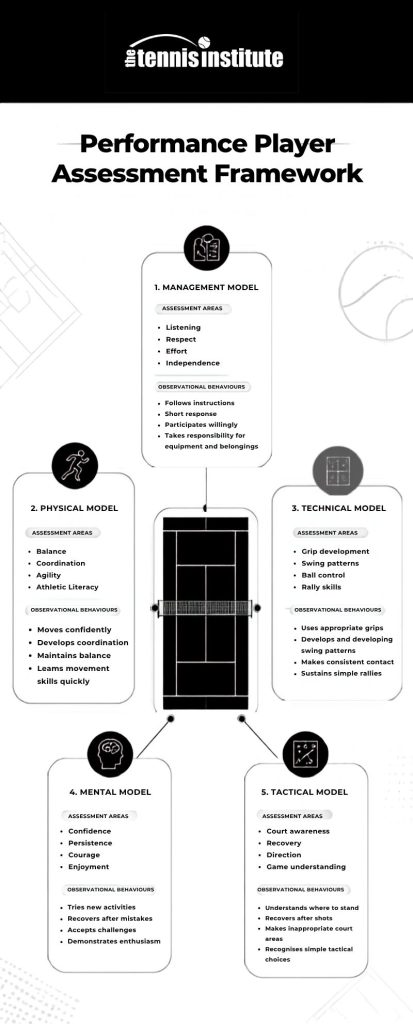
MANAGEMENT MODEL
Assessment Areas
- Listening
- Respect
- Effort
- Inderpendence
Observational Behaviours
- Follows instructions
- Shows respect
- Participates willingly
- Takes responsibility for equipment and belongings
PHYSICAL MODEL
Assessment Areas
- Balance
- Coordination
- Agility
- Athletic Literacy
Observational Behaviours
- Moves confidently
- Demonstrates coordination
- Maintains balance
- Learns movement skills quickly
TECHNICAL MODEL
Assessment Areas
- Grip development
- Swing patterns
- Ball control
- Rally skills
Observational Behaviours
- Uses appropriate grips
- Demonstrates developing swing patterns
- Makes consistent contact
- Sustains simple rallies
MENTAL MODEL
Assessment Areas
- Confidence
- Persistence
- Courage
- Enjoyment
Observational Behaviours
- Tries new activities
- Recovers after mistakes
- Accepts challenges
- Demonstrates enthusiasm
TACTICAL MODEL
Assessment Areas
- Court awareness
- Recovery
- Direction
- Game understanding
Observational Behaviours
- Understands where to stand
- Recovers after shots
- Hits into appropriate court areas
- Recognises simple tactical choices