
DEVELOPMENT PATHWAY MODELS
The purpose of assessment is development, not judgement.
The objective is not to identify what a player cannot do, but to identify the next area for growth.
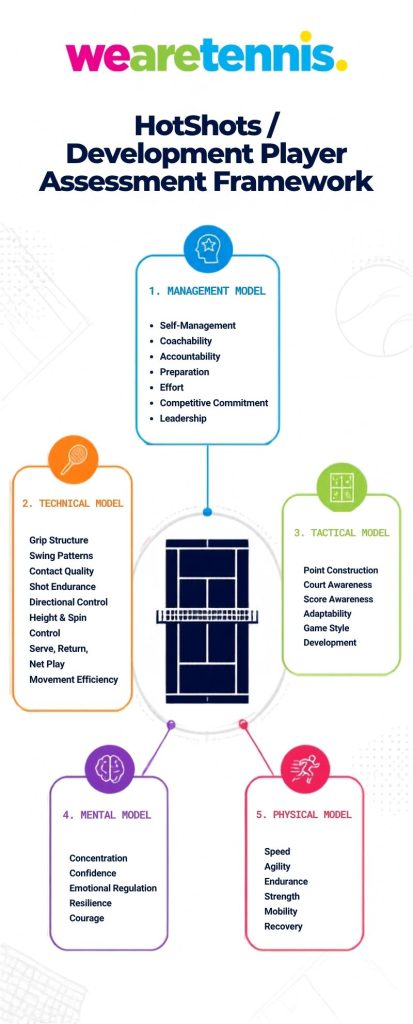
Within The Tennis Institute, we aim to develop complete players across five domains: Management, Technical, Tactical, Mental and Physical.
For performance players, our coaching process aims to develop the Technical and Physical domains as efficiently and effectively as possible. The long-term objective is for technique and
athletic capacity to become reliable and automated, so that within the competitive environment the primary differentiators become Tactical, Mental and Management factors.
MANAGEMENT MODEL
Assessment Areas
- Self-Management (Meta-Cognitive Awareness)
- Coachability
- Accountability
- Preparation
- Effort
- Competitive Commitment
- Leadership
TECHNICAL MODEL
Assessment Areas
- Grip structure
- Swing patterns
- Contact quality
- Shot endurance
- Directional control
- Height & Spin control
- Serve
- Return
- Net play
- Movement efficiency
TACTICAL MODEL
Assessment Areas
- Point construction
- Court awareness
- Score awareness
- Adaptability
- Game style development
MENTAL MODEL
Assessment Areas
- Concentration
- Confidence
- Emotional regulation
- Resilience
- Courage
PHYSICAL MODEL
Assessment Areas
- Speed
- Agility
- Endurance
- Strength
- Mobility
- Recovery
We Are Tennis Tactical Philosophy
We do not teach players to simply hit away from their opponent.
We teach players to hit the court and make the opponent move.
The objective is to allow the opponent to play the ball, but to make that task as difficult as possible.
Players should understand that the most effective target is often the open court, as it requires the
opponent to travel the greatest distance to reach the ball.
Tennis is not about hitting winners. Tennis is about creating increasingly difficult problems for your
opponent to solve.